Questions to ask daycare before you commit
By Babs Team · · 9 min read

A daycare can feel lovely on a tour and still leave important questions unanswered about the people, the care and the hours your family needs. You want to picture your child's ordinary day there, including the early drop-off or pickup that has to fit around another child's school. A useful conversation gets past the general reassurances. These questions help you understand the care itself and the practical terms you'll be living with. Babs can help both parents keep track of the emailed schedules and closures that follow enrollment.
Before the tour: openings and licensing
Ask to see the room or home space your child would use during care hours. ChildCare.gov's program visit tip sheets cover centers and family child care homes separately and include things to observe as well as questions to ask.
1. Is there a place for my child's age and the days we need?
Give the director or home provider your child's age, intended start date and needed days. Ask whether an opening is available now, promised for a future date or dependent on a waitlist.
For siblings, ask whether both places have the same start date and what happens if only one becomes available. Staggered starts can mean keeping another care arrangement alongside the new one. At a center, ask which room each child would enter and how later room moves work. At a home daycare, ask which ages share the group.
2. What is your licensing status, and where are your inspection records?
Ask for the program's licensed name and license number, or its explanation of a legal exemption. State and territory rules differ, including which programs must be licensed. Licensing sets minimum health and safety requirements; it does not guarantee care quality. ChildCare.gov explains licensing and legal exemptions.
For the responsible authority, select your state or territory on ChildCare.gov's state resources, then open “Understanding and Finding Child Care.” Follow the links to the licensing agency and provider inspection reports. That agency can explain the rules for this setting and age group, including staffing requirements and exemptions.
Inspection reports give you specific points to discuss. Ask what changed after a finding and how the program prevents it from happening again. Pay attention to the finding's substance, its date and the recorded corrective action. ChildCare.gov's inspection report guidance distinguishes substantiated complaints, meaning complaints investigated and found valid, from an allegation alone. A director's explanation adds context; the authority's record establishes the official finding.
Who will care for your child?
3. What qualifications and training do the caregivers in this group have?
Ask about their education, experience with your child's age group, ongoing training and current first-aid and CPR training. Include substitutes and assistants in the conversation about staff screening and preparation.
Requirements vary by state or territory, care setting and children's ages. There is no single credential to demand of every provider nationwide. ChildCare.gov's staff training guidance explains that distinction.
4. Will my child see familiar caregivers throughout the week?
Ask who handles opening, the middle of the day and closing, how long those caregivers have worked there, and how many staff changes the group has had recently. Then ask who covers absences.
Compare those shifts with your child's booked hours to see how many handoffs the day includes. Ask how covering adults learn the group's routines. Staff tenure alone doesn't tell you how a caregiver interacts with children; the visit helps you judge that.
For a home provider working alone, the absence question also affects whether care can open that day. Ask whether a substitute comes in or families arrange other care.
5. How many children and caregivers are in the group, including at opening and closing?
Ask for both the child-to-adult ratio and total group size. The ratio describes how many children there are per caregiver; group size tells you how many children share the space.
Four children with one caregiver and eight children with two caregivers both have a 4:1 ratio, but different group sizes. These are arithmetic examples, not recommended or legal staffing levels.
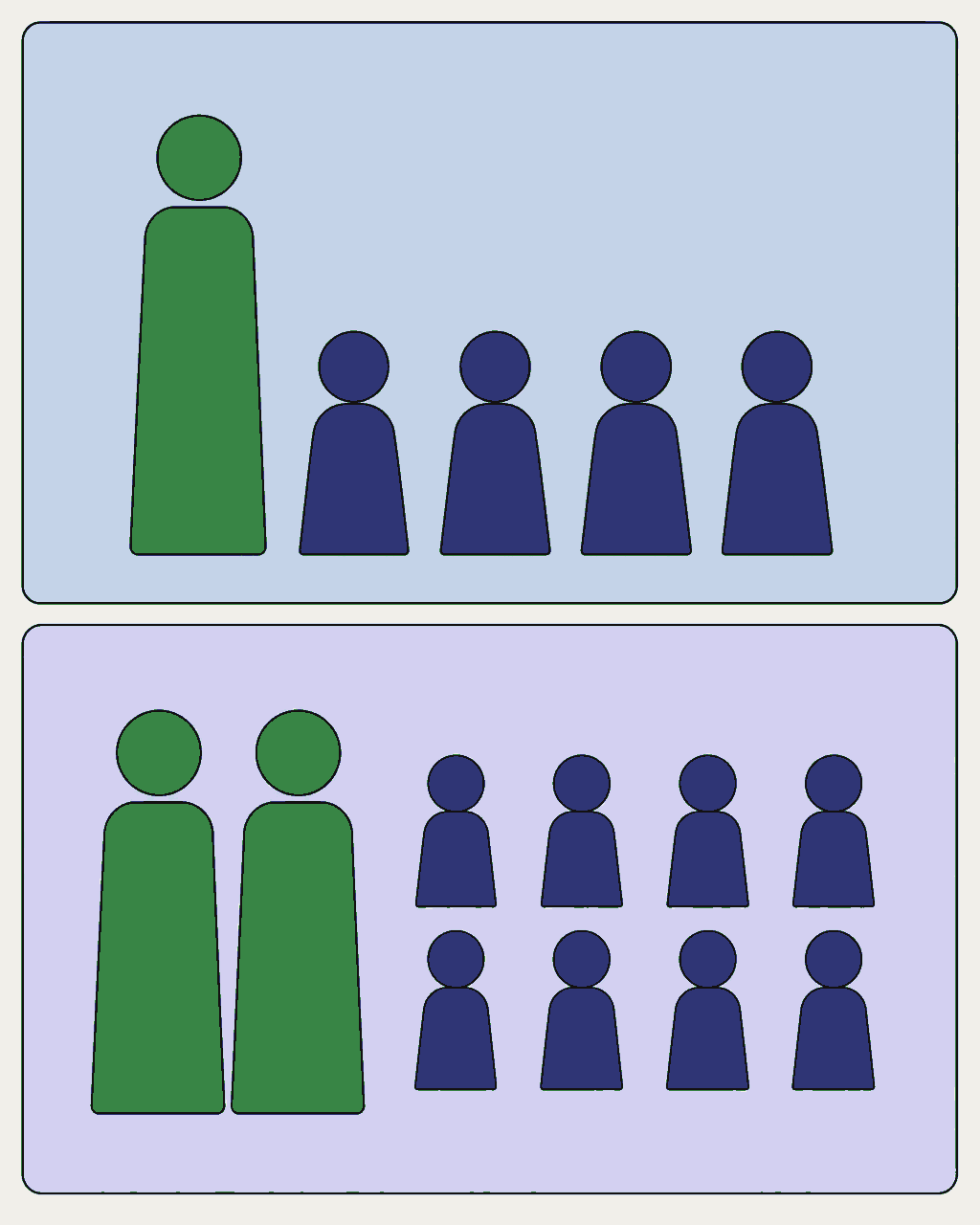
Ask how supervision works during staff breaks, bathroom trips, outdoor play and any combined groups at the beginning or end of the day. The answer needs to cover the hours your child will attend. Your licensing authority is the source for the applicable limits.
What will your child's day feel like?
6. Can you walk me through a typical day for this group?
Ask about play, outdoor time, meals, rest and quieter activities, including what happens when weather keeps everyone inside. Find out which spaces the children use and whether screens are part of the routine.
Look at whether children can reach and use the materials, where active play happens, and how adults join in or respond when a child needs help. If indoor days limit the group to one shared space, ask how caregivers make room for both active and quieter play.
For the daily handoff, ask which meals and supplies the program provides and which your family sends.
7. How do you respond when a child is upset or children have a conflict?
Ask a caregiver to describe their response to a familiar situation, such as a difficult goodbye or a disagreement over a toy. Listen for what the adult does and says, and whether that matches the interactions you observe.
Ask for the written behavior and discipline policy, including how parents hear about repeated concerns and when the program might ask a family to leave.
8. How would you help my child settle in, and what support can you provide?
Describe any relevant needs or preferences your family already knows about, such as the language spoken at home or a support arrangement your child currently uses. Ask how the program would accommodate them and where its limits are.
Find out whether there's an introductory visit, whether the first days have shorter hours and who talks with you about settling in.
Safety, entry and pickup
9. Who can enter, and how do you release a child to an authorized adult?
Ask the director to explain visitor access, sign-in and the pickup process. Include how a caregiver identifies someone they haven't met and how you add or remove an authorized adult.
If a grandparent or another caregiver will sometimes collect your child, ask what notice and identification the program requires, including for a same-day pickup change.
10. What happens if my child becomes ill, gets hurt or there's an emergency?
Ask who contacts you, which number they use first and what happens if that person doesn't answer. Find out how injuries are documented, how families receive emergency instructions and where children would go if the building had to be evacuated.
Request the written illness policy, including when a child must be collected and what the program requires before returning. There isn't one national return-to-care rule to assume. Emergency planning and illness procedures are among the areas covered by child care health and safety requirements.
Will the arrangement work for your family?
11. What hours would our place actually cover?
Ask about your booked arrival and collection times, any drop-off window and whether the advertised opening hours include care you're paying for. Find out how schedule changes work and what happens when pickup is late.
Consider the route on the days someone also collects a sibling from school. If care is part-time, ask whether you're paying for fixed days or can change them.
Babs scans connected Gmail for relevant events in daycare schedule emails. You review each suggestion, then add an approved event to Google Calendar in one tap.
12. When is care closed, and what happens during an unexpected closure?
Request the actual closure calendar. Ask about holidays, staff-training days and, for home care, the provider's planned time off.
Ask how weather or staffing closures are communicated and whether the program offers another care arrangement. Don't assume a home provider's substitute or a center's other location is included. The answer changes how much additional care your household may need, especially when daycare and an older child's school close on different days.
Babs can also flag emailed closure dates and later schedule changes for review. Shared events and to-dos let both parents see a daycare staff-training day alongside an older child's school plans, rather than leaving the closure in one person's inbox.
13. How will our household hear about the day, changes and concerns?
Ask which information comes through an app, email, phone call or pickup conversation. Find out whether both parents can receive routine updates, who handles a concern about care and how you contact that person.
Babs can suggest to-dos for emailed enrollment or form deadlines, which you accept in the app. Ask whether daycare-app notices also include the relevant details in an email. A notice kept only inside the daycare app still needs to be read there. The email-to-calendar guide explains how Babs works alongside your family's calendar.
Fees and the written agreement
14. What is the full cost of this place?
Ask for the rate for your child's age and schedule, plus registration, deposit, meals, supplies, extra hours and late-pickup fees where applicable. Find out which payments are refundable, whether a deposit is credited toward care, and how much notice precedes a rate change.
Also ask what you pay when your child is absent or the program is closed. Two identical tuition quotes can mean different costs once closures and additional charges are included. If you use child care financial assistance, ask whether the provider accepts it and which charges your family would still pay.
15. What are we agreeing to, and what happens if our plans change?
Request the handbook and enrollment agreement before paying a deposit. Ask about the notice needed to withdraw, any remaining payment obligation, and whether you can change days or reduce hours.
For an offered place, ask for written confirmation of the child's start date, group, booked days and hours, charges and required forms with their deadlines. For a waitlist payment, ask what it secures and whether it is refundable.
Choosing between the programs you've visited
Keep care concerns separate from practical trade-offs. An unresolved supervision or licensing question can't be answered by a shorter drive. For a concern about legal requirements or an inspection finding, the licensing agency can explain the official position.
Among arrangements you're comfortable with, compare the details that will change your family's week: the caregivers your child will see, the hours you can use, the closures you need to cover and the full cost. For example, a lower tuition rate may leave more planned days without care. A place for both siblings may simplify pickup, while their groups have different caregivers and routines.
If two programs both meet your care expectations, compare how each handles the day with the tightest pickups. Name who can collect each child within the booked hours, then account for the days that need another care arrangement. If an option depends on one parent leaving work early every week, that is part of its cost too.
Babs is a free family operating system in private beta on iOS. Join the Babs waitlist for help keeping emailed daycare schedules and closure dates visible to both parents.
Related articles

Family life · Babs
Minor passport checklist for U.S. children under 16
Prepare for your child's U.S. passport appointment with the required documents, copies, photo and fees, plus the separate route for ages 16–17.

Family life · Babs
Babysitter interview questions for the after-school hours
Ask about the after-school job your family actually needs, with practical follow-ups, fictional candidate replies and separate reference questions.