How to set up a family command center that stays useful
By Babs Team · · Updated · 11 min read

The field-trip form is on the counter, the soccer bag is upstairs, and the car leaves in eight minutes. A family command center gives those things a visible place along the routes your household already takes. That might be a whole wall, though one well-placed hook can be just as helpful. What matters is that people naturally pass it on the way in and use it again on the way out.
What is a family command center?
A family command center is a shared place where household information and everyday gear stay visible and within reach. It might take up part of a mudroom or spread across a kitchen counter and refrigerator. In a smaller home, it could be one hallway wall or a couple of practical spots near the everyday entrance. A calendar can be part of the setup, though plenty of families have no reason to add one.
The space usually helps with some combination of what is coming into the home and what needs to leave again. School papers and mail can wait there for a response, while library books, a packed sports bag, or a signed form can sit where they will make it back to the car or backpack. Some families also keep one or two current details in view, such as this week's school lunch menu or Saturday's pickup time.
There is good reason to keep the definition loose. A 2025 study of shared family scheduling included a survey of 277 people, interviews with 40 individuals, and a month-long calendar trial with 30 couples. The researchers found that families adapted their tools around their own routines while dealing with uneven participation, privacy concerns, and limited ways to customize them. A physical command center needs that same flexibility because the useful setup is the one that makes sense in your home.
Put it where information and gear already pass
One way to choose a location is to follow the route everyone takes from the usual door toward the kitchen, stairs, and bedrooms. Notice where backpacks come off, mail gets set down, or someone pauses to look for the keys. Those everyday habits tend to tell you more than a floor plan will.
A mudroom or everyday entrance can be handy for both arriving and leaving. You might put a sturdy backpack hook above a bin for tomorrow's cleats, shin guards, or dance bag. If school papers usually come out of the backpack there, a folder within the child's reach keeps the permission slip close to the bag that has to carry it back. In a home where everyone comes through the garage, there is no need to force this job onto the formal front hall.
A kitchen often works when papers already land on the counter and everyone comes through for breakfast. The current lunch menu can sit under a refrigerator magnet, with a shallow tray nearby for forms that need an adult to read or sign. A small calendar or whiteboard may also be useful if that is where the family already talks through rides and appointments while packing lunches.
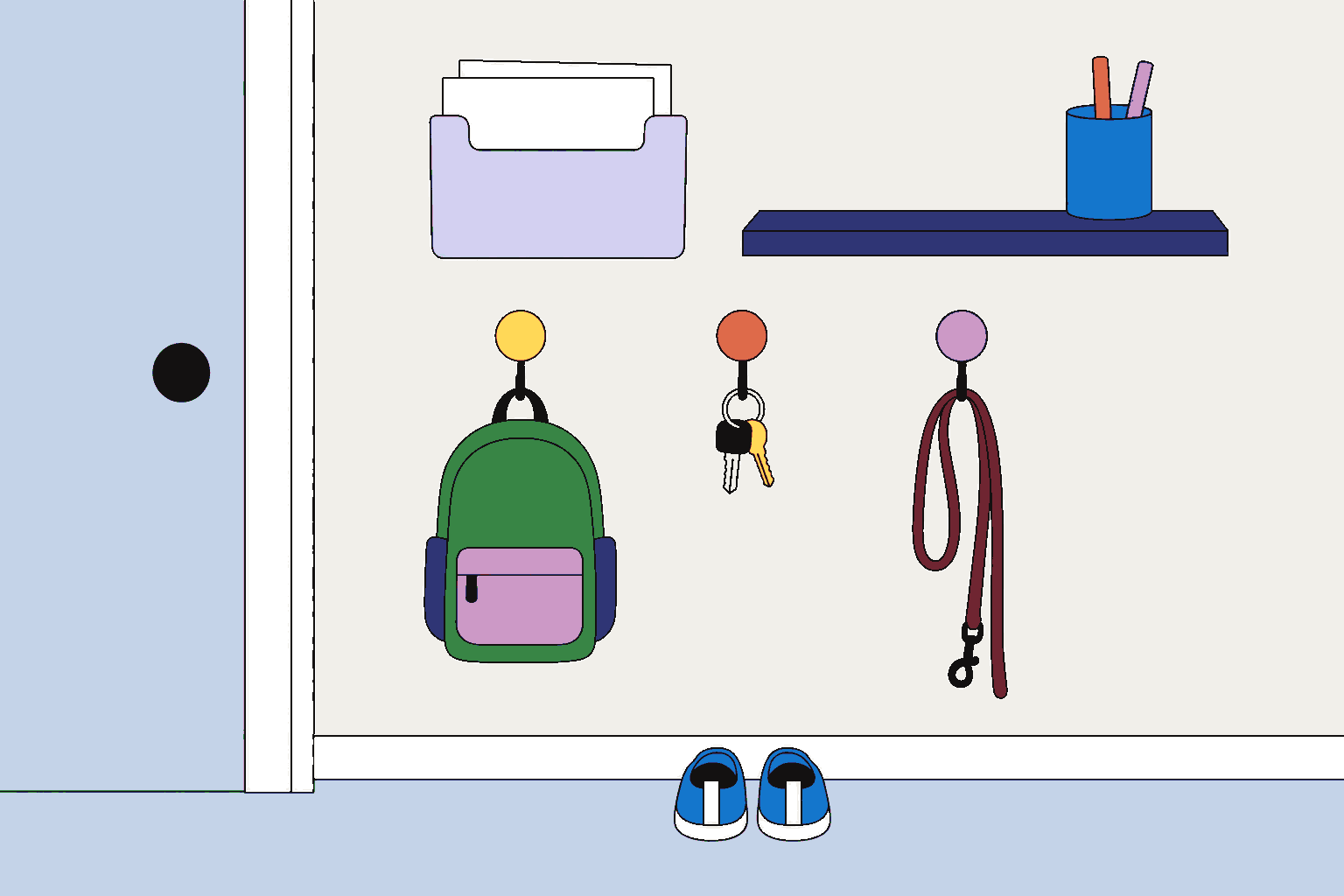
A hallway can do quite a lot without taking up much room. A clipboard can hold the school sheet everyone is checking this week, while a slim wall file catches forms without jutting into the walkway. One strong hook may be all you need for the library bag or another item that has to leave tomorrow. If your family needs a paper pocket, backpack hook, key hook, and pencil shelf, those can fit in a narrow entry too.
An office or closed cabinet can work when several people already open it during the day. If only one person remembers what is inside, though, it behaves more like that person's storage. The shared version is the one where a partner, child, grandparent, or sitter can find the thing they need and keep the handoff moving.
Some of the work a family needs to catch never becomes a piece of paper. School newsletters, game times, forms, and schedule changes often arrive in Gmail, where they can wait until somebody remembers to move them into the week. We built Babs, the family operating system for modern households, to help families catch and share that work so the whole household can see what needs to happen next. A parent connects Gmail and confirms context about the children, schools, and activities, and we gather possible events, to-dos, deadlines, and schedule changes for review. A parent then decides which suggested events belong in Google Calendar or Apple Calendar, making that approval the family's control point. Accepted to-dos can also be organized by child and deadline, with reminders that help the household follow through.
Choose pieces for the misses that keep happening
Family command center checklists can make a bare patch of wall sound like a shopping emergency. You can treat the ideas below as a menu and start with the question your family keeps asking or the thing that repeatedly misses its ride out the door.
- A school-lunch magnet can hold the current menu on the refrigerator, perhaps beside a small dry-erase magnet where a child marks the days they plan to buy lunch. It is most helpful where breakfast and lunch decisions already happen.
- A forms folder keeps papers that still need a signature or response where people can see them. A wall file, clipboard, or standing folder can all do the job, and labels by child may help when several schools are sending paper home. If forms are rare, one folder marked “return to school” may be plenty.
- A paper drop zone gives backpacks and incoming mail an obvious first stop, even if it is only a shallow tray on the counter. When that tray fills with catalogs, artwork, receipts, and spelling tests, moving each kind of paper to its usual home may solve more than adding another container.
- A tray for papers an adult needs to review can hold the bill, permission slip, or school notice that still needs a decision. Medical, financial, custody, password, and identity information belongs in secure storage instead of an open household station.
- A spot for tomorrow's gear can be a hook, cubby, bench, or clear patch of floor by the everyday door. The useful size depends on what goes there, whether that is an instrument, library books, shoes, or a lacrosse bag heavy enough to pull a decorative hook out of the wall.
- A small place for current notes might carry “Grandma has Thursday pickup” or “library books tomorrow.” A whiteboard, cork strip, or notepad can all work. Families who already share these reminders reliably in an app may be happier without one more board to update.
- Hooks and a charging spot can keep keys, dog leads, transit cards, and school devices near the route in and out. If devices charge there, placing the station by an outlet and securing the cords keeps them clear of the walkway.
These physical pieces can live in more than one spot. A forms tray in the kitchen and a sports-gear bench by the garage door can support the same handoff because each sits where that part of the work already happens.
Decide whether a calendar belongs there
A visible calendar helps when household members will actually look at it. That could mean a paper month view, a weekly pad on the refrigerator, or a digital wall display showing the family's selected calendars. If everyone already checks the same calendar on their phones, copying every appointment onto a wall can create another version that somebody has to keep current.
The questions people ask in that room can guide the format. A month view puts school closures, appointments, games, and travel in one quick scan, while a week view leaves more room for pickup details and locations. Writing names alongside colors also helps a grandparent, sitter, or child read the plan without having to remember that teal belongs to one child and orange to another.
Google Calendar or Apple Calendar is where the family's digital schedule lives, and we help find the events and to-dos still waiting in Gmail so a parent can review them. If a digital wall display shows a selected Google Calendar, the events a parent accepts into that calendar can then appear on the display through its Google connection. We help the family catch and review the event before that point, and the display shows what reached the calendar. With a paper calendar, a new event or corrected time still needs to be copied over by hand. Our guide to choosing a shared family calendar looks more closely at those tradeoffs.
Try the setup before mounting a whole wall
For the first week, an ordinary tray, a spare hook, a refrigerator magnet, and a cardboard file holder can stand in for a finished setup. That gives you time to see whether the location fits what people already do. If forms keep landing four feet away from the folder, moving the folder will probably go better than trying to teach everyone a new route through the kitchen.
Painter's tape is useful for marking the size and height of a wall calendar, file, or whiteboard before you drill. Stand where someone would read it, then open the nearest door or cabinet to see whether the two collide. Anything children are meant to collect or put away needs to be within their reach. For a digital display, look for a safe outlet, a place to secure the cord, and a position without strong glare. Private household details should also be out of sight from the front door or street.
After a normal school and work week, the changes usually become clear. The memo board no one checked can come down, the overflowing sports bin can move closer to the car, and the lunch menu can migrate from a frame across the room to the refrigerator. The first arrangement is allowed to change as your family figures out what is actually helpful.
Keep active work visible and move everything else on
The visible space stays readable when it holds things that still need somebody's attention. A permission slip can stay there while it needs a signature, then go straight into the child's backpack once it is signed. When a new lunch calendar goes up, the expired one can be recycled. Saturday's equipment can return to its regular storage after the game and come back to the door when it is packed for the next one.
The paper tray follows the same rhythm. A school form waiting for a decision makes sense there because somebody still needs to act on it. Once the family has answered it, the form can move to the backpack, recycling, or household files, depending on what comes next. If the tray keeps growing, it may be holding old papers and recycling alongside the few items that still need attention. Clearing those finished papers brings the next permission slip back into view.
A calendar also needs the occasional correction. Someone can erase a canceled event from a paper version, while a parent can review new digital details before accepting the change. That small follow-through is what gets the half day or moved practice out of the email and into the place the family actually looks.
Shared visibility is only part of the work
A family command center can help a child see that the library books are due, let a partner grab the packed soccer bag, and give a grandparent Saturday's pickup time without asking one person to narrate the entire week. Those visible cues let more people take part in the handoff. Even so, somebody still has to notice that a form arrived, decide what happens next, remember the deadline, and follow up.
A 2024 survey of 3,000 US parents found that mothers held most of the core daily cognitive work related to family wellbeing, while fathers held more episodic work related to maintenance and finances. Writing “cleats” on a board does not tell anyone that the old pair is too small and a replacement needs to be ordered by Friday. A shared task tool can carry the deadline and the name of the person handling it, while the command center keeps the shoes or written reminder where that person is likely to see it.
Your command center may be no more than a lunch-menu magnet and forms folder in the kitchen, or it may include a hallway calendar with the sports bag waiting beside the everyday door. Six months from now, middle school or a new Tuesday practice may change the arrangement. When the next person can see what is happening and carry the work forward, the setup is doing what your family needs from it.
If the paper side of the household is working while Gmail still holds a half day, a moved practice, and next Friday's form deadline, we can help with that part. Our iOS app connects to Gmail and is currently available through our waitlist. Join the Babs waitlist.
Related articles
Family organization · Babs
Google Calendar for family: a setup that stays clear
Set up Google Calendar for your family, choose the right sharing permissions, and use Babs to catch schedule details and deadlines in Gmail.

Family organization · Babs
Email to calendar: add events to your calendar without a ton of manual work
Turn emails into calendar events with Gmail and Outlook shortcuts, or let Babs find school dates, deadlines, and schedule changes buried in Gmail.