Is Character AI safe? A parent's guide to the real limits
By Babs Team · · 8 min read

When your child asks to use Character.AI, “it's just talking to a character” leaves a few things unanswered. Who can chat? What can a parent actually see? And what happens to the things a child types? A familiar face on a screen doesn't answer those questions, especially now that the platform's teen experience has changed.
What children can use on Character.AI now
Character.AI is an AI entertainment platform with user-created characters, roleplay and creative tools. Its characters generate responses. A character using a celebrity's name or presenting itself as a therapist is still an AI persona.
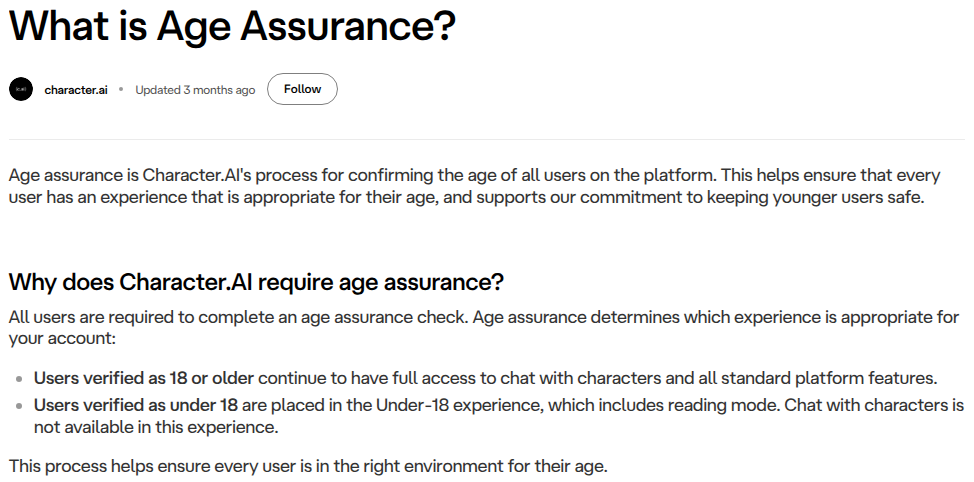
For a parent considering chatbot access, the current age rule is clear: users in the under-18 experience cannot chat with characters. Their account is placed in an under-18 experience that includes reading mode. Accounts assessed as adult can access character chat.
Character.AI began removing open-ended chat for under-18s in November 2025. It applies age assurance across accounts using signals such as login information, platform activity and third-party information. Someone assessed as under 18 who wants to establish that they are an adult can use a separate Persona verification process, beginning with a selfie and potentially requiring ID if the selfie is inconclusive. That does not mean every user submits a selfie or ID.
The minimum signup age is a separate rule. The terms prohibit signup under 13, or under 16 for citizens or residents of the European Economic Area or UK. Meeting that minimum does not give a teenager permission to chat.
In reading mode, under-18 users can browse characters, view existing chats and use creative and feed features. Removing conversation access changes the risk of a bot responding directly to a child. It does not settle whether the remaining content or time spent on the service suits your family.
What parents can see and control
Parental Insights is an optional connection for sharing screen time. It does not let a parent read or approve individual conversations.
| Safeguard | What it means for a family |
|---|---|
| Under-18 chat restriction | Accounts classified as under 18 do not have character chat. It is not a parent-selectable supervised chat mode. |
| Parental Insights | A connected adult can see screen-time activity and receive a weekly digest. The connection does not reveal messages or the specific content viewed. |
| Parent linking | Either side can disconnect. The parent is notified when a teen unlinks them. |
| Content moderation | Automated tools and human moderators address rule-breaking content. A content policy is not a guarantee that every response or item is appropriate. |
To connect, the teen opens Settings → Parental insights, enters the adult's email address and sends an invitation. The adult completes the linking steps from that email, including adult verification, to access Family Connect. An unanswered invitation does not create the connection.
Parental Insights cannot impose screen-time limits. A weekly report cannot enforce an agreed stopping time.
For device controls, families using Apple's Family Sharing can open Settings → Family → the child's name → Screen Time on the parent's iPhone or iPad. For a supervised Android device or Chromebook, open Family Link, select the child, then Screen time → Time limits → App limits, choose Character.AI and set the limit. An app limit and access to the Character.AI website are separate considerations.
These controls answer different questions. A usage report tells you how long an account was active. It cannot tell you whether a child was reading a fictional story, revisiting an old conversation or finding something upsetting.
What independent reviews have documented
Harmful content and responses in earlier testing
Common Sense Media's Youth AI Safety Institute rated Character.AI an “Unacceptable Risk” in its assessment dated April 10, 2025, and recommended against use by anyone under 18. Its testing found sexual content, dangerous advice and responses that promoted harmful behavior. It also found characters claiming to be real despite the platform's disclaimers. The risk assessment predates the removal of under-18 chat.
That timing matters. The assessment documents problems in the conversational experience available then. It does not establish that a teen in today's reading mode receives those same interactions. Equally, the later restrictions do not erase what the testing found or prove that every remaining feature is suitable for children.
Age checks have changed since earlier investigations
Australia's eSafety Commissioner published a transparency report in March 2026 on four companion services' reported practices during July–September 2025. It found weak age checks in that period. Character.AI later reported introducing age assurance for Australian users in early 2026. eSafety did not technically test or independently verify the providers' claims. The regulator separately noted that Character.AI had removed chat for Australian under-18s in early 2026. The regulator's report concerns earlier practices and subsequent changes, rather than a present-day product test.
For a family, the practical point is narrow: an old description of birthday-only access is incomplete. The existence of newer checks also does not establish how reliably they classify every account.
A convincing character is not reliable support
The American Academy of Pediatrics explains that companion chatbots can sound like caring friends while giving false or harmful answers. Its guidance encourages calm questions about what a child enjoys and whether a bot has said anything disturbing. It also warns that personal disclosures are not guaranteed to remain confidential. The pediatric guidance concerns chatbots generally, rather than an audit of Character.AI's current controls.
For older teens who previously used chat, and adults who can still use it, the distinction between fiction and advice matters. A character's warm tone, remembered details or professional-sounding name gives no assurance that its advice is accurate. A family disagreement or worry about health needs a person who can understand the situation and take responsibility for helping.
Are Character.AI conversations private?
Character creators cannot see the conversations people have with their characters. That does not make the conversation confidential from the company operating the service.
Character.AI collects information people provide and data from their interactions. Its stated uses include operating and personalizing the service, improving AI models and maintaining safety. Its terms also allow the company to access and review submitted content. A private character or a chat hidden from other users is therefore different from a confidential diary.
The useful family boundary is specific: keep identifying details about your child, siblings and other people out of prompts and character descriptions. A fictional story does not need a real school name, a sibling's diagnosis or screenshots of a family argument. The information concerns people who may never have chosen to use the service.
Did Disney buy Character.AI?
The announced Disney deal is a licensing bid in a bankruptcy sale process. It is not a completed purchase of Character.AI.
In its October 12, 2026 bankruptcy announcement, Character.AI named Disney Worldwide Services, a Disney affiliate, as the initial, or “stalking-horse,” bidder. The proposed deal covers a non-exclusive, perpetual license to certain intellectual property and company claims. The agreement provides for $20 million and transition services from former Character.AI employees hired by Disney. Other bidders can make higher or better offers.
Character.AI says the platform remains operational and its privacy and security practices are unchanged. It expects the sale process to finish in late November or early December 2026. The company update says the platform will be wound down if no actionable bid allows it to continue.
On October 14, a coalition of state attorneys general sought protections for sensitive consumer information in any sale. The Oregon DOJ release raises concerns about a possible transfer. It is not a finding that private chats have been sold.
Disney's involvement is no assurance of child safety or continued access. Future ownership and service continuity remain unresolved, and the existing privacy limits still matter. Avoid putting information into an entertainment platform that your family would need kept confidential.
Making the decision for your family
Start with what your child wants to do there. “Use Character.AI” can mean browsing a feed, making a character or wanting a private conversation with one. Those activities call for different decisions.
A child wants to chat with a favorite character. Under 18, that is outside the current platform rules. An adult's account or identity is not a supervised version of teen chat. The under-18 experience does not provide that option.
An eligible teen wants the creative features. The remaining decision concerns the content they will view or create, the personal information they might include and the time allowed. Parent linking can give visibility into usage, with the limits described above. It cannot approve each piece of content.
Your child already has a history with a character. Reading mode preserves past chats. Losing the ability to send new messages does not mean those conversations have disappeared. Ask what the character meant to them and what they want from it now, rather than assuming the platform change has answered that question.
Keep the conversation concrete: “What do you like doing there?” and “Has it ever said something you didn't expect?” give you more to work with than a debate over whether all AI is good or bad. The American Academy of Pediatrics recommends speaking with a child's doctor when they seem withdrawn and prefer chatbots to people.
Where more than one adult handles device decisions, agree on whether the restricted experience is allowed and which limits apply. A short family check-in can give children a place to raise questions without turning every request into a fresh negotiation.
Choose the permission for the actual activity your child wants, with the controls that actually exist. A familiar character does not get to make that decision for your household.
Related articles

Family life · Babs
The best family photo sharing app for your family’s rules
Compare FamilyAlbum, Google Photos, Apple Photos and Amazon Photos by who can view, add or remove pictures, device needs, storage, prices and data practices.

Family life · Babs
An Ollie alternative for your family's school-and-activity week
Ollie closes November 6, 2026. Keep Google Calendar events in place, handle Ollie-only reminders separately, and learn Babs's setup and sharing limits.